

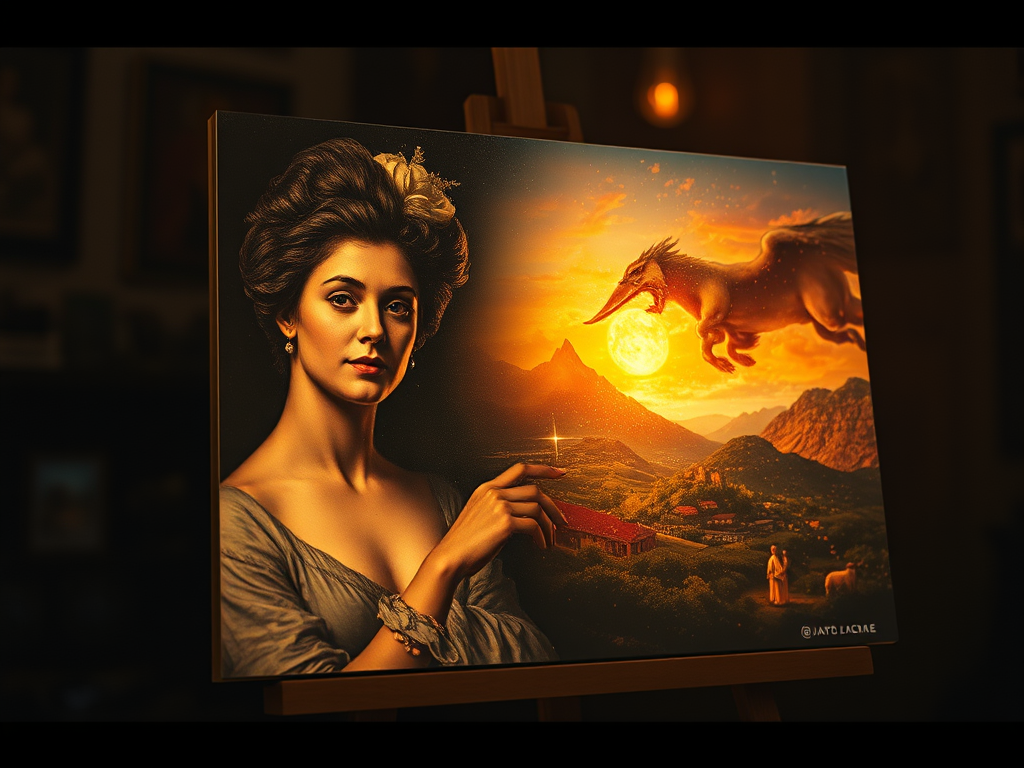

Imagine teaching a computer to paint not by copying, but by understanding the soul of an artist's signature style. This is the strategic core of AI style transfer, a technology that acts as a digital apprentice, deconstructing two distinct images to synthesize a third, entirely new work of art.
This process is a sophisticated blend of analysis and reconstruction, starting with two fundamental inputs:
- A Content Image: The "what." This is your structural foundation—the subject, composition, and layout. It could be a high-resolution 3D render, a corporate headshot, or a landscape photograph.
- A Style Image: The "how." This provides the artistic DNA—the brushstrokes, color palettes, and textural nuances. This could be a masterpiece from art history, a branded pattern, or any image with a distinct visual signature.

From Masterpiece to Mathematics
An AI doesn't "see" a painting through human eyes; it perceives it as data. A neural network meticulously breaks down the style image, quantifying its aesthetic properties—the directionality of brushstrokes, the dominant color harmonies, the recurring textures. For the content image, its focus is purely structural, preserving the underlying forms and spatial relationships that define the subject.
The true innovation lies in the balancing act. The AI's objective is to generate a new image that retains the content of the photograph while flawlessly adopting the style of the reference painting. This is a complex optimization problem, a mathematical tug-of-war managed by algorithms to find the perfect synthesis.
This is far more than a simple photo filter. The technique is built on extensive research into neural networks, with the field gaining significant momentum in 2015 following a groundbreaking paper by Leon Gatys, Alexander Ecker, and Matthias Bethge. Their method democratized the ability to transform ordinary photos into works that echo the masters, from Picasso to Van Gogh.
Forging a New Creative Partnership
Ultimately, AI style transfer is not a high-tech forgery tool; it's a new medium for collaboration. By applying the aesthetic "rules" of one artwork to the contextual framework of another, the AI generates something entirely novel—a work that neither the original artist nor the photographer could have conceived independently.
This opens a new frontier for creators to explore visual languages and produce stunning, one-of-a-kind assets. For professionals integrating this into their pipelines, understanding the underlying models and tools is paramount. This represents a true partnership between human creative intent and machine intelligence. Delve deeper into the practical applications in our complete guide to style transfer AI.
Behind the Digital Canvas: How AI Learns to Paint
How does an algorithm discern a photograph's structure from a painting's soul? It's not magic, but a feat of engineering built on a class of AI known as a Convolutional Neural Network (CNN).
Conceptualize a CNN as a multi-layered visual cortex. The initial layers perceive rudimentary elements—edges, corners, and basic colors. As data propagates deeper into the network, these layers begin to recognize more complex patterns: textures, shapes, and eventually, entire objects like a human face or a tree. This hierarchical perception is the key to decoupling what is in an image from how it is rendered.
Deconstructing the Task: Content vs. Style
The core strategy of style transfer is to assign the AI two distinct, often conflicting, objectives.
-
Content Reconstruction (The 'What'): One part of the network's function is to analyze the source photograph with a focus on high-level features. It learns to recognize the primary objects and their spatial arrangement—the architecture, the figures, the landscape composition. Its sole directive is to ensure that the final output remains structurally coherent and recognizable.
-
Style Reconstruction (The 'How'): The other part of the network receives a different directive. When analyzing the style image—for instance, a Van Gogh painting—it disregards the objects entirely. Instead, it concentrates on capturing the textural qualities, brushstroke patterns, and color palette. This artistic DNA is captured by analyzing feature correlations across the network's layers, often mathematically represented by a Gram matrix.
An Artistic Tug-of-War
Here, the synthesis begins. The AI initiates the process with a blank slate—a canvas of digital noise. It then commences an iterative optimization process, a push-and-pull to satisfy both objectives simultaneously.
The algorithm continuously adjusts pixels to minimize two distinct loss functions. It strives to reduce "content loss"—the deviation between the generated image and the original photo's structure. Concurrently, it works to minimize "style loss"—the difference between its output and the artistic fingerprint of the style reference.
Think of it as a negotiation between two competing masters. One is a realist, demanding structural fidelity. The other is an impressionist, insisting on a specific texture and emotional palette. The AI iteratively refines the image, seeking the equilibrium where the content is perfectly legible, yet imbued with the aesthetic soul of the style reference. This controlled conflict is what produces something genuinely new—not a filter, but a true synthesis of two visual paradigms.
2. Choosing Your AI Style Transfer Brush
In the world of generative media, AI style transfer algorithms are your digital toolkit. Just as a painter selects a specific brush for a desired effect, a creator must choose the right algorithm for the task. This decision fundamentally shapes the creative process, impacting speed, quality, and experimental freedom.
These digital "brushes" are not interchangeable. Some are slow and meticulous, designed for producing a single, perfect masterpiece. Others are optimized for the high-throughput demands of video and interactive applications. Let's analyze the three primary models you will encounter.
The Classic Method: Neural Style Transfer
This is the foundational technique that ignited the field. The original Neural Style Transfer (NST) method is still revered for producing images of breathtaking detail and quality. It operates by generating a new image from random noise, painstakingly optimizing it pixel by pixel to align the content structure with the style's texture and color.
The results can be museum-quality. However, this level of precision is computationally expensive, translating to long rendering times. NST is the ideal choice when crafting a single, high-fidelity piece where time is not a constraint, but it is impractical for real-time video or large-batch processing.
The Need for Speed: Fast Style Transfer
For production pipelines where latency is a critical factor, Fast Style Transfer is the solution. Instead of generating an image from scratch with each run, this method involves pre-training a feed-forward neural network on a single, specific style. Once this model has mastered the essence of, for example, Van Gogh's "Starry Night," it can apply that aesthetic to any content image almost instantaneously.
This remarkable speed makes it the tool of choice for stylized video effects or applications requiring live user interaction. The trade-off is its inflexibility. To apply a new artistic style, you must train an entirely new model from the ground up.
The Flexible Virtuoso: Arbitrary Style Transfer
What if you require both speed and flexibility? This is the domain of Arbitrary Style Transfer. Employing advanced techniques like Adaptive Instance Normalization (AdaIN), these models can apply any style to any content image in near real-time, without the need for style-specific pre-training.
This provides a powerful synthesis of the previous two methods. You gain near-instantaneous performance while retaining the creative freedom to mix and match styles from an infinite library. It's the engine driving many contemporary AI art platforms, offering creators a truly versatile and powerful digital toolkit.
To fully grasp the strategic implications, it's essential to compare these methods directly.
Comparing AI Style Transfer Algorithms
Here is a strategic breakdown of how these common style transfer methods compare in terms of speed, quality, and optimal use cases for professional creators.
| Algorithm Type | Key Characteristic | Processing Speed | Ideal Use Case |
|---|---|---|---|
| Classic NST | Highest possible quality, but very slow. | Very Slow (minutes/hours) | Creating a single, high-fidelity piece of art. |
| Fast Style Transfer | Extremely fast, but locked to a single style. | Real-time (milliseconds) | Live video filters, mobile apps, large-batch processing. |
| Arbitrary Style Transfer | Fast and flexible; can use any style image. | Near Real-time (seconds) | Creative exploration, interactive art generators, versatile tools. |
Ultimately, the optimal algorithm is dictated by your project's strategic goals—whether you require one perfect hero image or the rapid stylization of thousands of frames.
The chart below provides a stark visualization of the dramatic performance differential.

As illustrated, the performance gap between modern methods and the original NST technique is substantial. For today's professional creative workflows, this speed is a strategic imperative.
Your Practical AI Artistry Workflow
Let's transition from theory to execution. This is where the strategic application of AI style transfer begins.
Imagine you are a digital artist tasked with creating promotional assets for a new indie game with a painterly, dreamlike aesthetic. Your workflow doesn't begin with code; it begins with a critical artistic decision.

First, you must select your source images. The success of the final output is entirely dependent on the quality of your content and style references. For the content image, you select a crisp, high-resolution 3D render of the game's protagonist. For the style, you source a vibrant watercolor painting with rich texture and emotional depth that aligns perfectly with the game's art direction.
Fine-Tuning Your Creative Vision
With your assets selected, you now direct the AI. This is accomplished by adjusting key parameters that function as creative levers, instructing the model on how to balance the tension between content and style. The most critical of these is the style weight.
Consider style weight as the gain control for the artistic effect.
- A low style weight preserves the fidelity of your original character render, applying only a subtle hint of the watercolor style.
- A high style weight aggressively incorporates the watercolor's texture and color, potentially obscuring critical character details.
The true artistry lies in finding the optimal balance—that sweet spot where the character remains clearly defined but is beautifully reimagined with the watercolor's aesthetic. This is rarely achieved on the first attempt. Iteration is your most valuable asset. You might generate several versions, incrementally adjusting the style weight by 10-15% with each pass to observe the impact.
Overcoming Common Creative Hurdles
As you experiment, you will encounter common technical challenges. Managing image resolution is critical. If your content and style images have disparate resolutions, the AI can produce blurry or artifact-laden results. A pro tip: preprocess your images to a similar resolution before feeding them to the model.
Another classic challenge is feature mismatch. Applying the broad, sweeping strokes of a landscape to the delicate features of a portrait can be problematic for the AI. This is where your role as a creative problem-solver comes into play.
Your function is that of a director, not merely an operator. The AI is a powerful instrument, but it lacks artistic intent. You provide that intent. Through iterative refinement, parameter tuning, and even strategic edits to your source images, you guide the process toward a specific creative vision.
This feedback loop—generate, evaluate, adjust, repeat—is where true artistry emerges. It is precisely for this reason we engineered Legaci Studios. We manage the complex computational backend and provide an intuitive interface, removing technical friction. This liberates you to focus on what truly matters: experimenting, iterating, and realizing your unique creative vision.
The Evolution from Image to Imagination
The concept of separating an image's content from its style was more than a technical novelty; it was the seed of a creative revolution. This core principle—deconstructing an image into its "what" and "how"—laid the groundwork for the next monumental leap in generative media: text-to-image generation. Suddenly, the style reference no longer had to be a static image. It could be something far more abstract and powerful: an idea articulated through language.
This marked the moment AI style transfer transcended its technical niche to become a cultural force. Instead of requiring a Van Gogh painting as input, a creator could now guide an AI with a prompt like, "a bustling cyberpunk city street at night, in the style of a gritty graphic novel." The underlying logic is analogous, but the "style" is now synthesized from the vast network of correlations the AI has learned between words and visual data.
From Algorithm to Global Conversation
The inflection point arrived with the advent of diffusion models. These algorithms, which ingeniously construct an image by progressively refining random noise, propelled AI art into the mainstream with an unprecedented level of quality and coherence.
The technology's accessibility exploded around 2022, driven by these models and the user-friendly cloud platforms that democratized them. This was the year services like Midjourney launched their open beta, delivering powerful AI art generation to millions via a simple Discord interface. This movement was underpinned by latent diffusion models trained on massive global datasets, enabling them to generate breathtakingly detailed and stylistically sophisticated images from text alone. You can trace this evolution in this brief history of AI-powered image generation.
This screenshot from Midjourney's website showcases the kind of imaginative, high-fidelity artwork now accessible to all.
The image perfectly illustrates how a simple text prompt can be spun into a cohesive, artistically compelling scene—a feat that would have seemed like science fiction just a few years ago.
What began as a technical process for transferring texture between images has evolved into a system for transferring human imagination directly onto a digital canvas. The 'style' is no longer just a visual pattern; it's an emotion, a genre, or an entire artistic movement encapsulated in a few well-chosen words.
This evolution has armed creators with unprecedented power. A survey of the best AI image generation tools today reveals a landscape of boundless possibility, where the only constraint is the clarity of one's vision. The trajectory from image-based style transfer to modern text-to-image models demonstrates how a single technical innovation can unlock entirely new paradigms for human creativity.
Powering Your Creative Vision at Scale

Let's be direct: professional-grade AI style transfer demands more than a clever algorithm. It requires industrial-strength computational power. The stunning, high-resolution results that studios and professional artists demand are forged in the crucible of raw processing power. Without the right engine, the most brilliant ideas remain unrealized.
This is the critical juncture where ambition often collides with technical limitations. Attempting to render a single, complex image on consumer hardware can take hours, stifling the iterative process essential for high-quality creative work. And stylizing video or processing 4K assets? That is simply not feasible without an enterprise-grade infrastructure.
The true cost of inadequate infrastructure isn't just lost time; it's creative compromise. When technical constraints force you to reduce resolution, simplify styles, or abandon ambitious concepts, your vision is diminished to fit the limitations of your machine.
Engineered for Ambition
We built the Legaci Studios platform from the ground up to dismantle these barriers. Our mission is to provide creators with the computational horsepower required for large-scale projects, coupled with fine-tuned models and a workflow engineered for efficiency.
- Enterprise-Grade GPU Access: We abstract away the complexity and expense of backend infrastructure management. This grants you on-demand access to the processing power needed for high-resolution images and video, without the associated operational overhead.
- Optimized Workflows: Our entire platform is architected for the rapid experimentation that professional work demands, allowing you to iterate, refine, and see results without being bottlenecked by rendering queues.
The strategic advantage is clear: you can transition from small-scale experiments to building the large, ambitious projects you envision. You can focus entirely on your creative strategy, unburdened by the limitations of your hardware.
Got Questions? We’ve Got Answers.
As AI style transfer transitions from a novel experiment to an indispensable tool in the creator's arsenal, practical questions naturally arise. Mastering these concepts is key to moving beyond the hype and strategically deploying this technology in your work.
A common initial query is, "Isn't this just a sophisticated photo filter?" The answer is an emphatic no. A filter applies a uniform transformation across an image—adjusting color balance or adding a layer of grain. Style transfer operates on a fundamentally different principle. The AI is not merely tinting your photo; it is systematically deconstructing and rebuilding it from the ground up, using the learned artistic essence—the brushwork, textures, and compositional patterns—of the style reference.
Can This Be Effectively Applied to Video?
Absolutely. While the original algorithms were too computationally intensive for moving images, that is now a historical footnote. Modern techniques like Fast Style Transfer are specifically engineered for real-time application. This enables the application of a consistent artistic style across every frame of a video, a revolutionary capability for animation, VFX, and stylized film production.
The primary technical challenge is maintaining temporal consistency—ensuring the style doesn't flicker or "boil" between frames. Achieving this requires sophisticated models and significant processing power, but the results can be transformative.
Do I Need to Be an Artist to Leverage This?
No, and that is what makes this technology so transformative. The goal is not to replace artists but to empower a wider range of creators to visualize their ideas.
Your most critical skill shifts from technical execution to creative curation. Success becomes a function of your ability to pair the right content with the right style to achieve a specific aesthetic outcome. You don't need to paint like Van Gogh; you need the vision to see how his style could reimagine your photograph. Your ability to guide the AI with precise inputs is where the true value is created. To sharpen this skill, consult our guide on how to write effective prompts.
The AI manages the "how," liberating you to concentrate entirely on the "what."
Ready to realize your creative vision? With Legaci Studios, you gain access to the industrial-strength power required for high-resolution images, complex video projects, and rapid creative cycles, all without the technical overhead. Explore the platform and begin building your vision today at https://legacistudios.com.
Leave a Reply