

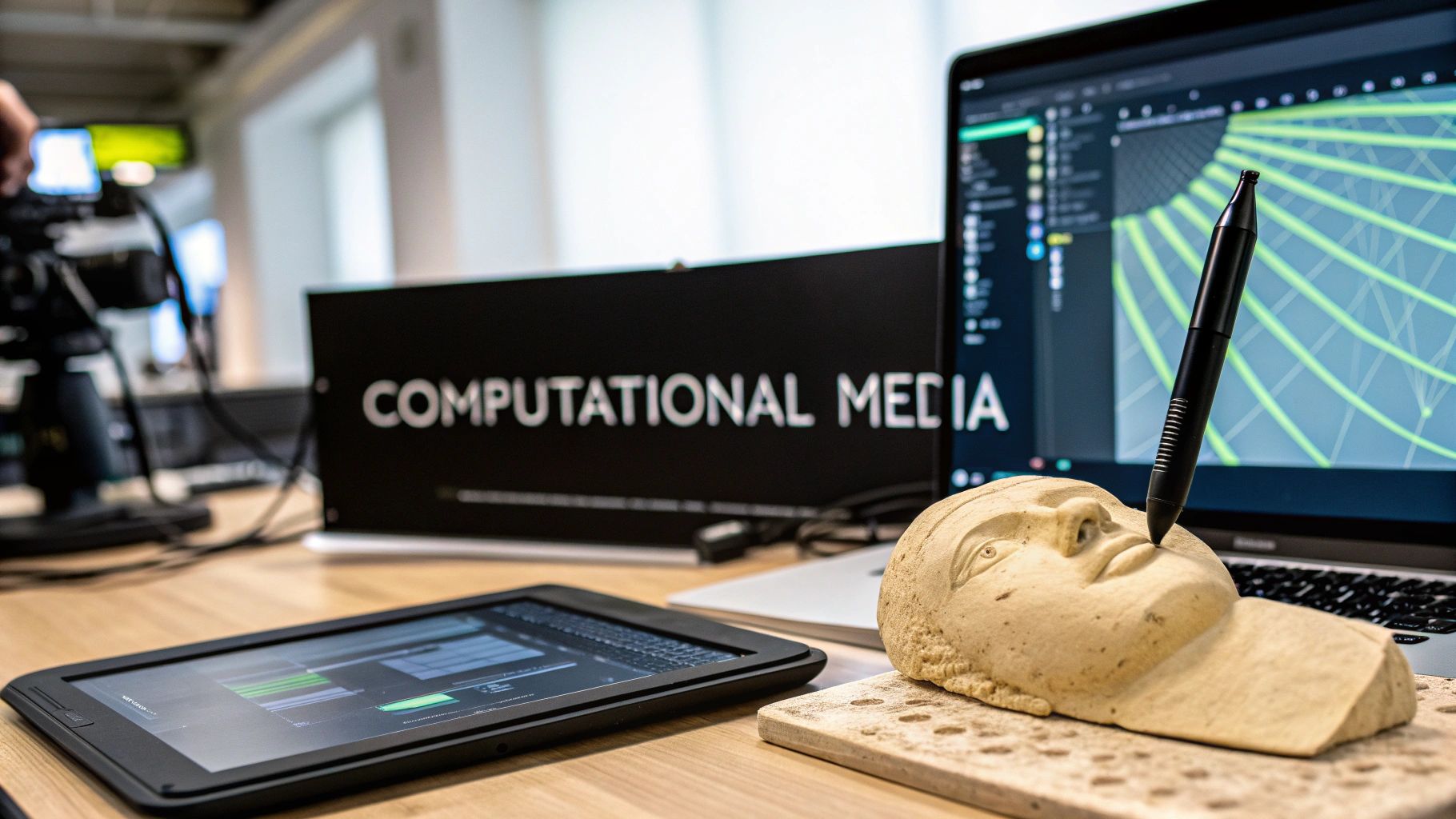

At its core, what is computational media? It’s the point where computer science stops being a mere tool and becomes the artistic medium itself. Instead of simply leveraging technology to create something, computational media treats computation as the raw material—the digital clay you can sculpt into entirely new, interactive experiences.
Defining the New Creative Canvas
Imagine you’re a painter. But instead of just mixing colors on a palette, you’re inventing pigments that react to the world. One color might glow brighter depending on the sound in the room, while another shifts its shade based on the local weather. That’s the heart of computational media. It turns the creative process from a one-way street into a dynamic dialogue between the artist, the audience, and the technology.

This isn’t just about using software to make art. It’s about writing the rules for a tiny universe and then letting it unfold. Think about a digital sculptor. A traditional sculptor has a chisel and a block of marble—the tool is separate from the material. With computational media, the code is both the chisel and the marble. It defines the creation’s shape, texture, and behavior, giving creators the power to build experiences that can think, react, and even evolve on their own.
The Fusion of Disciplines
At its heart, computational media is a multidisciplinary field, a creative crossroads where distinct areas of expertise converge to build something entirely new. It isn’t about mastering just one skill; it’s about the powerful synergy that occurs when several fields connect.
This convergence is best understood by looking at its three core pillars. Each brings a unique and essential ingredient to the table, and without all three, the strategic power of computational media wouldn’t be possible.
The Three Pillars of Computational Media
| Discipline | Contribution to Computational Media | Example Application |
|---|---|---|
| Computer Science | Provides the logical framework, algorithms, and processing power that form the technical backbone of the work. | Developing the physics engine that governs how objects interact in a real-time virtual production environment. |
| Art and Design | Brings in aesthetics, storytelling, and human-centric principles to ensure the final product is meaningful and strategically engaging. | Designing the visual style and user interface for an interactive brand experience. |
| Human-Computer Interaction (HCI) | Focuses on the “conversation” between the user and the system, making interactions intuitive, responsive, and impactful. | Creating gesture controls for an augmented reality application that feel natural and enhance the user’s immersion. |
This blend is what sets it apart from traditional digital media. A static JPEG photo is digital, but a generative art piece that creates a unique image for every single viewer? That’s computational. The second is alive, driven by processes that allow for rich, interactive moments. This unique academic approach treats the computer as an expressive medium, empowering students not just to use software, but to write the very code that brings interactive games, animations, and special effects to life. You can explore more about these educational frameworks that truly see the computer as a creative partner.
The real shift is in mindset, moving from seeing the computer as a high-powered calculator to seeing it as a collaborative partner with its own potential for expression. It’s about building systems, not just static objects.
Ultimately, mastering computational media means recognizing this fundamental change. It gives creators at studios like Legaci.io an incredible ability to build worlds that aren’t just viewed, but truly experienced—worlds that can surprise even the people who made them. This way of thinking sets the stage for the powerful generative tools that are now redefining what’s possible in art, storytelling, and interactive design.
From Calculation to Creation: The Journey of Computational Media
To fully grasp the strategic implications of generative AI today, it helps to analyze its origins. The story of computational media isn’t a simple timeline of technological progress. It’s about a fundamental shift in how we perceive computers—from giant, room-filling calculators to partners in the creative process. This journey began not with artists, but with mathematicians and engineers focused on solving complex computational problems.
The first computers were incredible machines, but they were built for one thing: crunching numbers. Their output wasn’t a beautiful image or a piece of music; it was a stack of punch cards filled with data. The idea that a machine could have an “imagination” was pure science fiction, a world away from the serious work happening in university and military research labs.
But as the technology advanced, that perspective began to shift. The first steps were rudimentary pixelated graphics—simple shapes and lines appearing on bulky, monochrome screens. These early visual experiments, often confined to academic labs, were a monumental leap. They represented the first flicker of a new idea, the moment creators started asking, “What if this machine could do more than just compute? What if it could create?”
The Big Shift: From Logic to Expression
That single question changed everything. It required a paradigm shift: seeing computers not as rigid, logical machines but as a new, dynamic medium for human expression. The pioneers in this space began to treat the computer less like a sophisticated calculator and more like a new kind of canvas—an interactive one, governed by rules they could write and rewrite on the fly.
This new field, what we now call computational media, truly began to take shape in the 1990s and early 2000s. The driving force was a desire to use computers as expressive tools, to make things that had never been seen or heard before. For instance, a teaching method called Media Computation emerged, which taught programming by allowing students to manipulate media directly. They’d write code to alter pixels in a photo or tweak sound samples, making abstract concepts like loops and variables feel tangible and engaging. Diving into the history of these educational models reveals how these foundational ideas began to spread.
This was the moment computation broke free from the world of pure math and started dipping its toes into the arts. It was the birth of the idea that an algorithm could have an aesthetic, that a line of code could evoke an emotional response.
Building the Foundation for Today’s Tools
The groundwork laid by these early innovators was absolutely crucial. They built the first computer graphics algorithms, tinkered with the first interactive systems, and championed the concept of the computer as a creative partner. Their experiments with procedural generation—using code to create complex patterns and structures—were the direct ancestors of the powerful generative AI models we have now.
These pioneers blazed the trail that leads straight to the incredible, AI-driven tools available on platforms like Legaci.io. They proved that code could be a paintbrush, a camera, and a symphony orchestra all rolled into one. This long journey from pure calculation to creative collaboration is what makes this moment so electrifying. We aren’t just using better tools; we’re standing on the shoulders of visionaries who saw the artistic soul in the machine, transforming it from a simple calculator into a boundless engine for creativity.
The Creative Engine: How It All Works
To truly understand what makes computational media tick, we need to analyze its core engine. It’s a dynamic machine built on three foundational concepts: interactivity, generativity, and algorithms. These are not just technical buzzwords; they are the strategic components that empower creators to build media experiences that feel alive.
Consider this analogy: a traditional film is a perfectly rehearsed symphony, beautiful but identical with every viewing. A piece of computational media is more like a live jazz performance. There’s a core melody, but it improvises and riffs based on the audience’s energy, making every performance unique.
Interactivity: A Two-Way Conversation
First is interactivity. This is what transforms a passive viewer into an active participant. It establishes a dialogue between the art and the person experiencing it. Every click, every swipe, even a user’s physical movement can cause the media to react, creating a feedback loop where the audience directly influences the outcome.
This extends far beyond a simple “play” button. Imagine a museum installation where the music shifts based on your position in the room. As you and others wander through the space, you are collectively composing a constantly changing soundtrack. Your path creates a personal audio journey that no one else will experience in exactly the same way. That’s interactivity in action.
Generativity: Planting a Digital Seed
Next is generativity, which can be understood as planting a digital seed. Instead of hand-crafting every single pixel or sound, the creator designs the DNA—a set of rules, styles, and constraints. The system then uses that genetic code to “grow” an entire forest of unique creations that all share the same family resemblance.
This enables infinite variety within a single artistic vision. For example, a generative artist could build a system for creating abstract floral patterns. They’d define the rules for color palettes, petal shapes, and growth behavior. Every time the program runs, it produces a brand-new, one-of-a-kind flower that still feels like it came from that artist’s hand. To see how far this idea has evolved, our guide on what is generative AI dives into the modern tools that are pushing this concept forward.

This visual breaks down how these foundational concepts build on each other to create modern digital stories. Algorithms provide the base, supporting the dynamic processes that ultimately lead to powerful, audience-driven experiences.
Algorithms: The Creative Recipe
Finally, algorithms are the recipes that bring it all together. They are the step-by-step instructions—the musical score or the choreography—that guide the entire system. In this context, algorithms are not just for crunching numbers; they are for creating art.
Algorithms define how the system reacts to you (interactivity) and what it creates on its own (generativity). In a branching narrative game, an algorithm determines which path the story takes based on your choices. In a piece of generative music, an algorithm selects the next note to play in an endless melody.
These three elements aren’t separate. They are intricately woven together. The algorithm sets the rules for the generative system, which creates the world you interact with, and that interaction feeds right back into the algorithm.
Once you grasp this, you begin to see that computational media is more than just a new toolbox. It’s a complete shift in creative strategy, moving from making static objects to designing dynamic systems—systems that can respond, evolve, and even collaborate with their audience. It’s a framework for making media that has a life of its own.
Your Toolkit for the Digital Frontier
Understanding what computational media is provides the theoretical foundation. But taking control of its practical application is where the real strategic advantage lies. The creative landscape today is packed with powerful, surprisingly accessible tools that turn abstract ideas like “interactivity” and “generativity” into something you can see, touch, and deploy. These are not just software programs; they are entire ecosystems for building living, breathing media.

This image from the official Processing.org website is a perfect snapshot of this principle. You’re not looking at a static painting. You’re seeing visual art born from a script—a powerful example of code itself becoming a creative medium.
The Rise of the Creative Collaborator
Leading the charge into this new territory are Artificial Intelligence (AI) and Machine Learning (ML). The most effective way to view them is not as automated assistants, but as creative collaborators. They can analyze your past work to understand your unique style, then generate new concepts, textures, or even melodies that feel like a natural extension of your own creativity. For any professional, this is a game-changer for breaking through creative blocks and exploring new directions at a velocity that was impossible just a few years ago.
Instead of staring at a blank canvas, you can now provide an AI with a simple concept and receive a dozen visual starting points in seconds. This is fundamentally rewiring the creative workflow. The creator’s role is shifting from that of a pure originator to becoming more of a director or curator of ideas. If you want to dive deeper into this, our complete guide on AI tools for content creation is an excellent resource.
Real-Time Engines Blurring Creative Lines
For decades, film production and video game development were entirely different worlds, each with its own specialized toolset. Today, real-time game engines have completely dismantled that wall. Powerhouses like Unreal Engine and Unity are no longer just for games. They have become central hubs for everything from interactive storytelling and virtual film production to complex architectural visualizations.
Think of these engines as the ultimate sandboxes for computational media. They come loaded with sophisticated physics simulators, photorealistic lighting systems, and visual scripting tools that let artists build complex, interactive worlds without needing to be master coders. This has democratized the creation of immersive 3D experiences, allowing independent studios to produce work that can rival major industry players.
The true power of these engines is their immediacy. You can tweak lighting, change a character’s animation, or swap out an entire environment and see the result instantly. This fosters a fluid, iterative process that feels more like sculpting than programming.
Modern Tools for Computational Media Creators
Navigating the vast ocean of creative software can be daunting. To help you select the right tool for your project, here’s a breakdown of some of the most prominent platforms and frameworks that professional creators are using today.
| Technology/Tool | Primary Use Case | Best For Creators Focused On |
|---|---|---|
| Unreal Engine | High-fidelity 3D rendering and real-time interaction | Photorealistic visuals, virtual production, and architectural visualization. |
| Unity | Versatile 2D/3D game development and interactive experiences | Mobile games, indie projects, and cross-platform AR/VR applications. |
| Processing | Creating visual art and learning to code in a visual context | Generative art, data visualization, and educational projects. |
| p5.js | Interactive web-based art and creative coding for the browser | Web-native interactive graphics, online art projects, and creative coding education. |
| TouchDesigner | Real-time interactive multimedia and generative visuals | Live performance visuals, interactive installations, and node-based programming. |
| Arduino | Physical computing and interactive hardware projects | Interactive art installations, custom electronic devices, and IoT projects. |
Each of these tools offers a unique gateway into the world of computational media, whether your canvas is a screen, a web browser, or the physical world itself. The optimal choice always depends on your project’s specific strategic goals.
Creative Coding for Artists and Designers
While game engines offer immense power, a more direct and lightweight approach is sometimes needed to experiment with code. This is where creative coding frameworks excel. They are built from the ground up for artists, designers, and beginners, making programming feel more like sketching in a notebook than engineering a complex system.
- Processing: Often called the grandfather of creative coding, Processing is a flexible software sketchbook that lets you learn to code through the lens of visual art. Its simplicity and massive community make it an exceptional starting point.
- p5.js: This is a JavaScript library that takes the brilliant ideas behind Processing and brings them straight to the web browser. With p5.js, your canvas is the internet, making it incredibly easy to create and share interactive art that runs on any device.
These frameworks are designed to lower the barrier to entry, proving you don’t need a computer science degree to start creating powerful work with code.
Bridging the Digital and Physical Worlds
Finally, the toolkit extends beyond the screen. Physical computing platforms like Arduino and Raspberry Pi allow you to connect your digital creations to the physical world. These small, affordable microcontrollers can read inputs from sensors—detecting light, sound, or touch—and use that data to control real-world outputs like lights, motors, and displays.
This creates a tangible bridge between your code and physical reality. Imagine an art installation where visuals react to the number of people in a room, or a sculpture that plays different sounds when touched. Physical computing makes these interactive experiences possible, truly embodying the core idea of computational media by making our environment a participant in the art itself.
How Computational Media Is Reshaping Our World
The true power of computational media isn’t just a theoretical concept; it’s in the tangible, often breathtaking, experiences it makes possible. Once you understand the building blocks, you start seeing them everywhere, revolutionizing one industry after another. We’ve moved far beyond video games; we’re now in an era where art, data, and our daily lives are deeply intertwined.
These are not just flashy tech demos. They represent powerful new methods for communication and expression, transforming us from passive consumers into active participants. From art galleries to newsrooms, creators are leveraging these principles to forge deeper, more meaningful connections with their audiences.
Immersive and Interactive Art Installations
One of the most stunning applications of computational media is in the modern museum or gallery. Artists are no longer limited to creating static objects for walls; they’re building entire environments that respond to your very presence. Picture an installation where projections on the floor swirl and change color based on where you and others walk, turning the crowd’s movement into a collaborative, ever-shifting digital painting.
These incredible pieces often integrate several key technologies:
- Motion Sensors (like Kinect): These track visitors’ positions and gestures in real time.
- Projection Mapping: This allows dynamic visuals to be cast onto complex, three-dimensional surfaces, not just flat screens.
- Generative Algorithms: These are the brains of the operation, ensuring the visuals are always unique and never repeat, creating an endlessly fresh experience.
The ultimate goal here is to make the audience part of the art. The piece isn’t complete until someone steps into the space, turning the simple act of observation into an act of creation. It’s interactivity brought to life, completely blurring the line between the observer and the observed.
The New Era of Data Storytelling
Journalism is also being completely reimagined. We’re moving away from static charts and conventional graphs toward living, interactive data visualizations. Instead of merely telling a story with numbers, data journalists now build tools that empower you to explore the information for yourself. This approach can turn dense datasets about climate change, economic trends, or public health into powerful visual narratives.
For example, a news organization might build an interactive map that lets you scrub through decades of demographic data, literally watching cities grow and change before your eyes. By placing the user in control, the information becomes far more personal and impactful. This kind of storytelling often relies on a robust cloud computing infrastructure to handle and deliver massive datasets to thousands of users simultaneously, ensuring the experience remains smooth and responsive.
In this new model, the story isn’t a single article; it’s a dynamic system for understanding. The user’s curiosity drives the narrative, leading to a much deeper and more memorable comprehension of the topic.
Endless Soundtracks and Augmented Realities
Computational media’s influence extends beyond visuals; it’s also transforming sound and our very perception of the world. Generative music systems can now create endless, non-repeating soundtracks for apps, games, and even physical spaces like cafes or hotel lobbies. An algorithm, armed with a set of musical rules and emotional cues, can compose a unique score for every single listener, adapting to their actions in the moment.
Simultaneously, Augmented Reality (AR) is layering our physical world with digital intelligence. Using your phone, you can point your camera at a historic building to see a reconstruction of its original facade, or look at a product on a shelf and see reviews and animations appear around it.
These experiences are perfect examples of code and culture colliding. They demonstrate what is possible when creators move beyond making static media and start designing dynamic systems—systems that listen, react, and turn our world into an interactive canvas.
Your Questions on Computational Media Answered
Navigating any new creative field can feel like learning a new language. As the lines between art, code, and user interaction blur, it’s natural to have questions. This section addresses the most common challenges that artists, developers, and studios encounter when exploring computational media. Think of it as a strategic briefing to clear up any confusion so you can move forward with confidence.
Do I Need to Be a Master Coder to Work in Computational Media?
Absolutely not. This is arguably the biggest misconception that prevents talented professionals from entering this space.
While a foundational understanding of coding logic is beneficial, you do not need a computer science degree. The key is to view code as another creative tool in your arsenal, like a paintbrush or a camera, rather than a rigid engineering discipline.
Many powerful tools are designed specifically for creative professionals. Creative coding frameworks like Processing and p5.js were built with artists in mind, offering more forgiving learning curves than traditional programming languages. Furthermore, the rise of node-based visual scripting in software like Unreal Engine and TouchDesigner allows you to build incredibly complex, interactive logic simply by connecting blocks together—no lines of code required.
The most critical skill is not writing perfect syntax, but computational thinking. It’s about learning to deconstruct your creative vision into a series of logical steps, rules, and relationships. This mindset can be developed using any of these tools, empowering you to direct technology without needing to be a full-stack software engineer.
What Is the Difference Between Digital Media and Computational Media?
This is a crucial distinction that comes down to a single concept: static versus dynamic.
- Digital Media encompasses any media that a computer can store and display. A JPEG photo, an MP3 file, or a standard video are all forms of digital media. They are finished objects that you edit directly with tools like Photoshop or Premiere Pro. The file itself is the final product.
- Computational Media is alive. It’s dynamic, procedural, and often generative. Instead of editing the final piece directly, you design the process—the algorithm—that creates or modifies the media on the fly in response to data or user input.
The key differentiators are interactivity and variability. A digital photo appears identical every time you open it. A piece of computational art, however, might change based on a user’s touch, live data from the internet, or its own internal rules. It could be subtly different with every single viewing.
In computational media, the artist’s final output isn’t just the image or the sound; it’s the system that produces an endless stream of images or sounds. You are designing the creator, not just the creation.
How Is AI Changing the Field of Computational Media?
Artificial intelligence, particularly generative AI, is acting as a massive accelerator for the field. It is both a hyper-efficient tool and a new kind of creative partner, fundamentally changing production workflows. We are moving away from manually defining every rule and into a new era of collaborating with intelligent systems.
In the past, building a generative art piece required an artist to meticulously define every parameter—a complex and time-consuming process. Now, with AI, you can train a model on a vast dataset—your own past work, an entire artistic movement, a specific aesthetic—and then work with that model to generate outputs you could never have imagined on your own.
This completely redefines the creator’s role. An artist is no longer just a “rule-maker” but also a “curator,” a “guide,” or a “creative director” for an AI. It is enabling us to create media that is not just interactive but truly adaptive and deeply personalized. We’re unlocking new ways to tell stories and design experiences that were simply out of reach just a few years ago, enabling a level of creative complexity that was once unthinkable. This is precisely the kind of powerful, next-generation control that professional studios need to maintain a competitive edge.
At Legaci.io, we’re building the engine for this new creative world. Our platform is designed from the ground up to give professional creators, developers, and studios the power and control they need to build the next generation of generative and computational media. Break free from restrictive platforms and unlock your true creative potential by visiting our official website.
Leave a Reply