

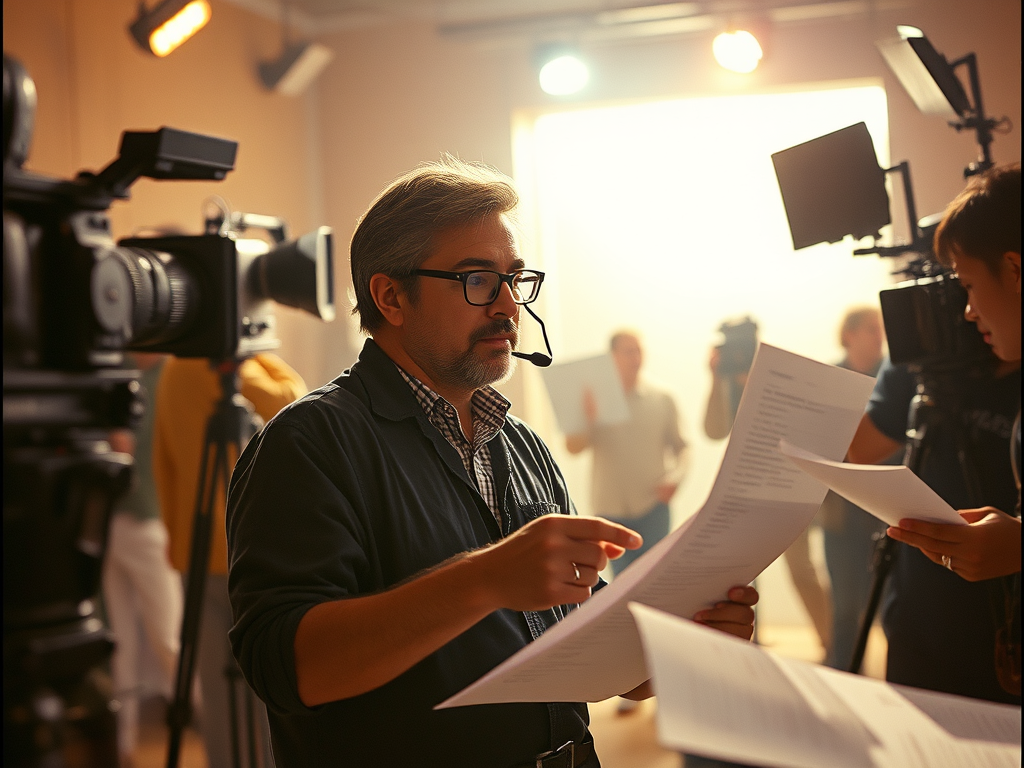

Have you ever been so lost in a movie that the real world just melts away? That incredible feeling isn’t an accident. It’s the direct result of masterful continuity in filmmaking—the unsung hero that makes you believe in the world on screen. Think of it as the foundational grammar of visual storytelling, a discipline now on the verge of a technological revolution.
The Invisible Thread Weaving Your Favorite Films Together

At its heart, continuity is the invisible thread stitching individual shots into a single, cohesive story. It’s the reason a character’s half-empty glass doesn’t magically refill in the next shot, or why their hair isn’t bone-dry seconds after they just walked through a torrential downpour.
It’s the painstaking work of ensuring every single element—from a prop on a table to a strand of hair—remains consistent from one shot to the next.
When executed flawlessly, you don’t even notice it. That’s the entire point. Perfect continuity allows you to stay completely absorbed in the characters and their journey, without jarring mistakes pulling you out of the experience. Even one tiny error can shatter the fragile illusion that filmmakers work so hard to create.
The Guardian of Consistency
This monumental responsibility falls squarely on the shoulders of the script supervisor. This individual is the on-set authority for all things continuity, serving as the director’s strategic partner and the editor’s most vital asset. They are the human database for every single detail.
A script supervisor meticulously tracks everything, including:
- Dialogue and Action: Ensuring actors deliver lines and perform actions identically across every take to enable seamless editing.
- Props and Set Dressing: Monitoring the placement, condition, and position of every single object within the frame.
- Wardrobe and Makeup: Verifying that a character’s costume, hair, and makeup appear identical, even if the shots are filmed days or weeks apart.
- Screen Direction: Maintaining consistent eyelines and ensuring characters are positioned logically to prevent spatial disorientation for the audience.
In essence, a script supervisor is one of the most essential roles on set. They act as the central nervous system for multiple departments, ensuring the massive, scattered jigsaw puzzle of a film can be pieced together seamlessly in post-production.
This job is about so much more than just catching “bloopers.” It’s about protecting the film’s internal logic and believability. As we’ll explore, this timeless craft is receiving a profound upgrade with modern digital tools and generative AI, enhancing the human eye to further perfect the art of seamless storytelling.
How Hollywood Perfected Seamless Storytelling
To fully grasp why continuity in filmmaking is so vital, you have to rewind to the dawn of cinema. Early films were essentially stage plays captured by a single, locked-off camera. The concept of cutting from one shot to another to guide the audience’s attention hadn’t been invented yet. It was a visual language waiting to be born.
Everything changed when the pioneers of the silent era began to experiment. They started slicing up their footage, cutting between different angles and shots, and realized they could construct a scene from pieces instead of merely recording it whole. This was the birth of cinematic grammar. Suddenly, techniques like the match-on-action cut and the 180-degree rule weren’t just tricks; they were essential storytelling tools that kept the audience from getting lost.
The Rise of a Visual Language
It was during Hollywood’s golden age that these practices were codified into the law of the land. The studio system was a well-oiled machine, transforming filmmaking into an industrial-scale assembly line. For that machine to function, everyone—from the director to the editor—needed to be fluent in the same visual language.
Continuity editing became that universal dialect. It was the foundation that allowed studios to produce an astonishing volume of films. At its peak between the 1930s and 1950s, the U.S. film industry was releasing over 700 feature films a year. That kind of output was only possible because of these established continuity standards. You can find more insights about this historical production boom and its global ripple effect.
This systematic approach meant that no matter what genre you were watching—a western, a musical, a gangster flick—the underlying logic of how the story was presented remained the same. This consistency was crucial for audiences. It allowed them to slip into the narrative without being jolted out of the experience, connecting them to the characters on a deeper, more psychological level.
Continuity wasn’t just about avoiding goofs. It became the very architecture of classical Hollywood storytelling. It was the invisible framework that made complex narratives not only possible but also profoundly immersive, turning cinema into the powerful art form we know today.
Looking back, you can see that continuity is so much more than a stuffy set of rules. It’s the creative discipline that gives filmmakers the freedom to build intricate worlds and tell emotionally powerful stories, confident the audience will be right there with them, every step of the way. It’s the art of making the edit disappear, leaving only the story.
The Unsung Hero of On-Set Continuity

Ever watched a movie and noticed a character’s coffee cup mysteriously refill itself between cuts? Or seen a hero’s hard-won battle scar jump from the left side of their face to the right? The person whose entire job is to prevent these immersion-breaking mistakes is the script supervisor. They are the on-set guardian of a film’s internal reality.
This role is far more than mere note-taking. A great script supervisor is a strategic partner to the director and the editor’s best friend. They are the living, breathing database for every single visual and narrative detail, creating the essential blueprint that makes post-production possible.
Think of them as the film’s dedicated air traffic controller. It’s their responsibility to make sure every element—every line of dialogue, every prop, every actor’s glance—lands exactly where and when it’s supposed to. They prevent the world of the film from collapsing under the weight of its own inconsistencies.
The Architect of a Believable World
A day in the life of a script supervisor is a masterclass in focused observation. Armed with a script, a stopwatch, and an almost superhuman eye for detail, they are constantly cross-referencing the written page with what’s happening in front of the camera. Their duties are incredibly specific and absolutely critical.
Dialogue and Action: They meticulously track every spoken word and physical action. This ensures that when an actor begins to sit down in a wide shot, the movement can be seamlessly cut with a close-up that might be filmed hours—or even days—later.
Props and Set Dressing: Every single object on set is their domain. Was that book open or closed? Where on the table was that wine glass placed? They document it all.
Emotional Journey: It’s not just about physical objects. They also track the emotional state of the characters. This is vital for ensuring an actor’s performance intensity aligns with where they are in the story, especially since films are almost never shot in chronological order.
These detailed notes become the holy grail for the editing team. Editors lean heavily on these reports to assemble the thousands of puzzle pieces, confident that the takes they choose will cut together smoothly. In this way, the script supervisor is the crucial bridge connecting the chaos of production to the storytelling of post-production. The foundation they lay is as important as knowing how to make an animatic; both are about creating a solid plan for the final visual narrative.
The script supervisor is the silent protector of the audience’s suspension of disbelief. By catching tiny errors before they’re baked into the final cut, they save productions a fortune in time and money, preventing expensive reshoots and keeping the magic of the movie alive.
Their tireless work is a constant reminder that in filmmaking, the smallest details often make the biggest difference. They are the guardians who ensure the world on screen doesn’t just look believable—it feels real.
A Closer Look at the Types of Film Continuity
Continuity isn’t a monolithic concept; it’s a collection of specific, interlocking details that must align perfectly. To view it as a single job is to misunderstand its complexity—like saying a conductor just “waves a stick.” The reality is far more intricate, a harmony of different elements that together build a believable world for the audience.
To truly appreciate what’s at stake, you have to break continuity down into its core components. Each type represents a silent promise made to the viewer—a promise that the world on screen plays by its own rules, no matter how many times you cut, change angles, or break for lunch.
This visual provides a bird’s-eye view of how all the pieces fit together, from pre-production to the final cut.

As you can see, continuity isn’t just something that happens on set. It’s a thread that runs through the entire filmmaking process, starting long before the cameras even roll and stretching deep into post-production.
The Main Pillars of On-Screen Consistency
When you get down to brass tacks, most continuity challenges fall into a few key categories. A failure in any one of these risks shattering the very illusion you’ve worked so hard to create.
Spatial Continuity: This is all about the physical layout of your scene. Where are things, and where are people? If Character A is on the left and Character B is on the right, they need to remain in those positions across different shots. This covers everything from consistent eyelines to adhering to the classic 180-degree rule, which keeps the audience grounded and spatially oriented.
Temporal Continuity: This governs the flow of time. It’s about ensuring that if a scene starts at sunset, the next cut doesn’t suddenly show a high-noon sun. It also maintains the logic of time—a five-minute chat can’t occur while a one-minute egg timer runs out in the background. Such an inconsistency feels fundamentally wrong to the viewer.
Performance Continuity: This is arguably the most subtle and challenging type. It concerns an actor’s emotional and physical state. If an actor delivers a line with quiet rage in the wide shot, they must bring that exact same energy and body language to the close-up—even if it’s filmed hours, or even days, later.
Technical Continuity: This is the category most associated with classic movie “bloopers.” It’s the coffee cup that vanishes and reappears, the half-eaten sandwich that’s suddenly whole again, or the magical disappearing stain on a shirt. This bucket also contains all the crucial details of wardrobe, hair, and makeup. For a better sense of how crews meticulously review footage, check out our guide on how to extract video frames for analysis.
These practices are more critical now than ever. In 2023 alone, the global film industry pushed out around 9,511 films. That’s a massive 68% jump from the production slump we saw in 2020. With that kind of volume, rock-solid continuity is what prevents the entire storytelling machine from collapsing.
The Future of Continuity: AI, Modern Tools, and the Human Touch
The meticulous, century-old craft of maintaining continuity in filmmaking is undergoing a profound technological transformation. For decades, the script supervisor’s kit consisted of a binder, a pen, and a Polaroid camera. Those analog days are rapidly fading into the rearview mirror.
Today’s sets are powered by sophisticated software that has completely changed the game. The script supervisor’s binder has gone digital. Tools like Scriptation allow supervisors to instantly mark up and distribute script changes to the entire crew. Meanwhile, platforms such as LockitNetwork function as a central, cloud-based brain for all production metadata, ensuring everyone—from camera and sound to the editing bay—is operating from a single source of truth. It’s not just about speed; it’s about making the entire process more accurate and truly collaborative.
The Rise of the AI Assistant
As impactful as digital software has been, the next great leap forward is being driven by artificial intelligence. Generative media and AI-powered analysis are emerging as the script supervisor’s newest and most powerful allies. This isn’t about replacing the human expert on set. It’s about augmenting their abilities with the kind of computational precision only a machine can offer.
What can an AI system realistically do? Imagine this:
- Analyze takes in real-time: It could instantly scan camera feeds, logging the exact position of every prop, actor, and piece of set dressing.
- Automate tedious tracking: It could automatically record wardrobe details, check for smudged makeup, and even track an actor’s eyeline from one take to the next.
- Flag errors proactively: The AI could intelligently compare a new take against established continuity, alerting the script supervisor to a potential mismatch before the director even calls “cut.”
Freeing Up the Human Expert
This human-AI partnership creates a future where the AI handles the exhausting, data-intensive labor—acting as a hyper-aware assistant that never blinks. This frees the script supervisor to focus on what humans do best: the nuanced, artistic side of the job. Tasks like tracking the subtle arc of an actor’s performance or catching a shift in emotional tone are skills that require deep empathy and strategic insight.
For anyone tracking how these technologies are reshaping the creative landscape, exploring AI tools for content creation offers crucial context on the broader industrial shift.
Consider this: a platform like Legaci.io could be fed a film’s dailies, learning the specific visual “rules” of that movie’s world. From there, it could intelligently flag potential continuity errors, queuing them for human review and verification. Nothing would slip through the cracks.
The demand for these advanced tools is only accelerating. Even with some regional dips in early 2025, scripted content still accounted for a massive 71% of all new projects. The U.S. alone kicked off Q1 2025 with 1,318 new projects, as detailed in a recent report on production dynamics.
In such a high-volume environment, managing continuity with razor-sharp accuracy is essential for keeping a story coherent and a budget intact. At this scale, AI isn’t just a luxury; it’s becoming the critical partner we need to protect that all-important cinematic illusion.
Answering Your Questions About Film Continuity

Even after grasping the fundamentals of continuity in filmmaking, a host of practical questions inevitably arise. This is natural. Good continuity is designed to be invisible, which makes one wonder about the edge cases and “what if” scenarios that occur on a real-world set.
This section delves into some of the most common head-scratchers, moving past theory and into the nitty-gritty of how continuity actually functions on the ground. Understanding these answers will provide a much deeper appreciation for the artistry and strategic challenges that go into making the films you love.
Why Do Continuity Errors Still Happen in Big-Budget Movies?
It’s an excellent question. When millions of dollars are on the line, how does a modern coffee cup end up in a fantasy epic? The simple truth is that filmmaking is controlled chaos. A movie set is one of the few places where you almost never do things in order. You might shoot a scene from the film’s climax on day two, then film the opening sequence five weeks later.
This non-linear schedule makes tracking every tiny detail a monumental task. A slight shift in daylight between takes, a prop getting nudged by an inch, or an actor’s last-minute creative impulse can throw everything off. Furthermore, a director will sometimes look at a minor continuity goof and consciously decide to live with it. They might possess a take with a far more powerful, emotional performance from an actor, and they’ll choose to prioritize that raw emotion over perfect visual consistency.
A core reason these errors make it to the final cut comes down to pure economics. Reshoots are outrageously expensive and a logistical nightmare. If an error is small enough that the majority of viewers won’t notice, the studio may decide it’s simply not worth the cost to fix it.
It’s all part of the constant balancing act between artistic perfection and the practical realities of making a movie. It’s a game of calculated trade-offs, and more often than not, performance wins.
Can You Intentionally Break Continuity for Artistic Effect?
Absolutely. While most films strive for that “invisible” style where the illusion is never broken, some of the most brilliant directors in history have deliberately shattered continuity to make a point. This technique, often called discontinuity editing, is an incredibly powerful tool for creating a specific feeling or psychological state.
Look no further than the French New Wave filmmakers of the 1960s. They were famous for using “jump cuts”—abruptly leaping forward in time within the same shot—to create a restless, rebellious energy that perfectly mirrored their characters’ chaotic minds. In the same way, intentionally breaking the 180-degree rule can make a scene feel jarring and disorienting, throwing the audience directly into a character’s fractured mental state.
When executed with clear intent, breaking the rules of continuity in filmmaking ceases to be a mistake. It becomes a sophisticated artistic choice, a way of using the language of film to express something that dialogue or action alone cannot convey.
How Is Continuity Managed in Animation and VFX?
In animation or films heavy on visual effects, continuity is every bit as critical, but the entire process exists within a computer. Instead of a script supervisor on a physical set with a binder, you have teams of artists, animators, and coordinators managing consistency through incredibly detailed digital asset management systems.
Their toolkit looks a little different:
- Detailed Storyboards: These serve as the initial blueprint, locking down character positions, camera angles, and key actions very early on.
- Animatics: Think of this as a rough, animated version of the film. It establishes timing and spatial relationships long before the expensive, time-consuming final rendering begins.
- Digital Asset Libraries: Every character model, virtual prop, and digital background is a complex asset. These massive libraries ensure that the texture on a superhero’s suit or the exact design of a spaceship stays perfectly consistent across hundreds of shots, even when handled by different artists in different studios across the globe.
Coordinators will painstakingly track details like accumulating battle damage on a starship or the slow weathering of a castle wall throughout the story’s timeline. In this digital world, continuity becomes a function of meticulous data management, all to ensure the final product is completely seamless.
What Is the Most Important Skill for a Script Supervisor?
A great script supervisor needs a whole toolbox of skills—from killer organization to on-set diplomacy—but if you have to pick just one, it’s an unwavering attention to detail. They must possess an almost supernatural ability to spot the tiny things everyone else misses. It could be the way an actor is holding a glass, a logical jump in the scene’s timeline, or a slight change in a character’s hairstyle between takes.
Of course, that eagle eye is useless without fantastic communication skills. A script supervisor has to be able to relay that information clearly and diplomatically to the director, actors, and department heads, often under the intense pressure of a film set. They are the sworn guardians of the film’s internal logic, and that’s a job that demands a truly unique and dedicated person.
At Legaci.io, we are building the tools that empower creators to bring their ambitious visions to life with greater control and precision. Whether you are managing the complex details of a feature film or generating groundbreaking art, our platform is designed to support the next generation of storytellers. Discover how our hybrid infrastructure can give you the creative freedom you need at https://legacistudios.com.
Leave a Reply